

Bold insights. Real stories. Practical wine tips from top winemakers, sommeliers, and industry pros.
The Wine Centric Show makes wine more accessible—for everyone.
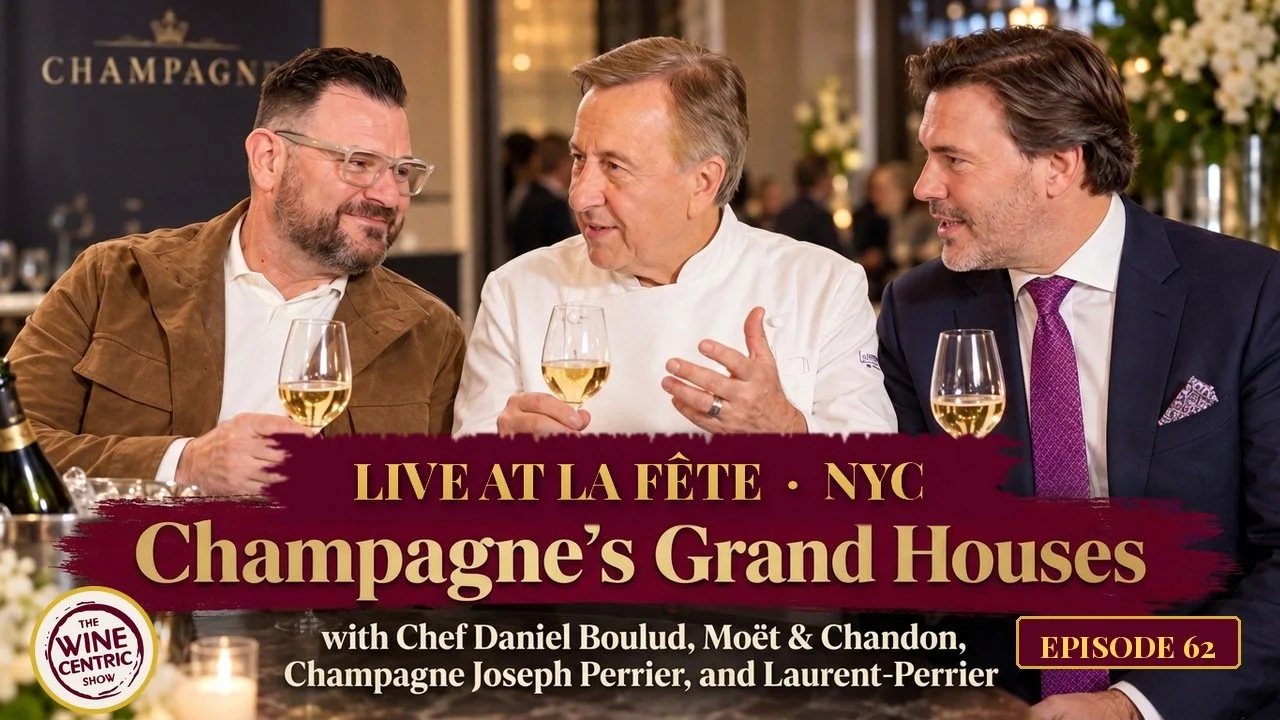
Daniel Boulud and the Titans of Champagne: Live at La Fête du Champagne
Moët & Chandon is cutting the sugar in Brut Impérial to 5 grams per liter within six months, and its chef de cave explains why. Recorded live at La Fête du Champagne in New York, with Chef Daniel Boulud and the families behind Joseph Perrier and Laurent-Perrier.
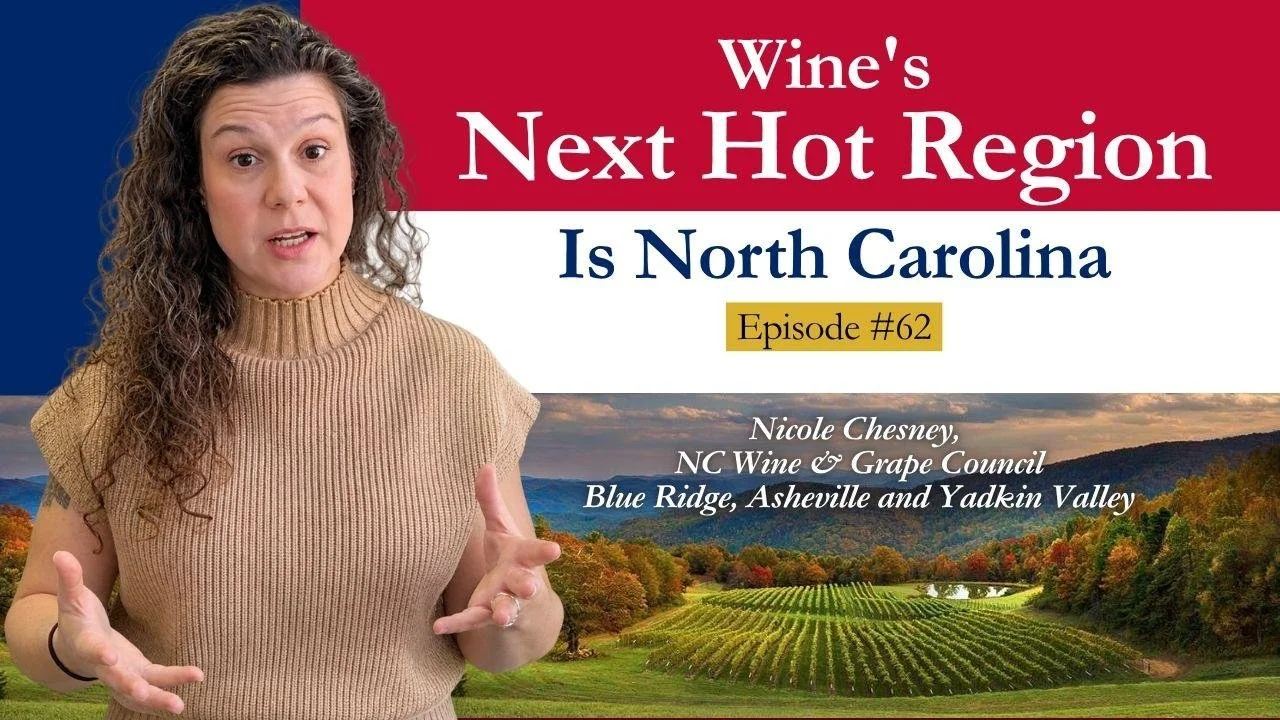
Wine's Next Hot Region Is North Carolina | Nicole Chesney, NC Wine & Grape Council
This summer, Wine Enthusiast named North Carolina one of seven up-and-coming wine regions to watch, on the same list as Bolivia. Nicole Chesney, executive director of the North Carolina Wine & Grape Council, makes the case for going there to taste it.
Nicole walks Matt Weiss through a four-day North Carolina wine trip, from the muscadine producers of Johnston County to the Yadkin Valley, Hendersonville near Asheville, and the Tryon Foothills. Along the way, she explains which grapes could define the state, from Petit Manseng and Cabernet Franc to hybrids like Chambourcin and Traminette, and names the hybrid white she would pour over Sauvignon Blanc.
They also get into Biltmore and its North Carolina-only wines, the viticulture and enology program at Surry Community College, and how the soils shift from the red clay of the Triangle to the mountains. Nicole explains how small production makes a North Carolina bottle cost more than an imported European one, then closes with her North Carolina wine, cider and sparkling picks for the Thanksgiving table.

Beyond Expectations Lars Maack: A Farm Bought by Accident, Built on Sauvignon Blanc | South Africa Series Part 5 of 5
Lars Maack says the farm was offered to his family over drinks in a pub, for about the price of a double garage in Germany. Today Buitenverwachting, known in the US as Bayten, is one of the best-known Sauvignon Blanc estates in Constantia.

The South Africa Series ends in Constantia, South Africa's oldest wine region, a few miles from Cape Town. Matt Weiss talks with Lars Maack, who took over the estate from his parents in his twenties. Lars explains how the farm moved from Riesling to Sauvignon Blanc, how his family found Sauvignon Blanc cuttings when apartheid had closed South Africa off, and how two cold oceans make Constantia better suited to Sauvignon Blanc than Chardonnay. He also compares Constantia and New Zealand Sauvignon Blanc, makes the case for drinking dessert wine at the start of a meal, and tells the story of Constantia's sweet wine, once prized by Europe's royal courts, and how the region lost its winemaking entirely. The conversation closes with his son taking over the day-to-day running of the farm.

Buitenverwachting means "beyond expectation" in old Dutch. The estate was once part of Simon van der Stel's original Constantia farm, and the Mueller family revived it in the early 1980s.
Kanonkop's Johann Krige: The Pinotage Still Stunning After 50 Years | South Africa Series Part 4 of 5
Kanonkop opened its 1973 Cabernet Sauvignon and Pinotage to celebrate 50 years of bottling its own wine, and Johann Krige says both were stunning. He credits a fermentation that finishes in about three and a half days.

The South Africa Series continues in the garden at Kanonkop in Stellenbosch. Matt Weiss talks with Johann Krige, who co-owns the estate with his brother Paul. Johann explains how the family cut Kanonkop down to Cabernet Sauvignon and Pinotage, with a little Merlot and Cabernet Franc for blending, and how bush vines keep the Pinotage concentrated. He also explains how being a Krige won't get you a senior job, what Americans get wrong about Pinotage, and his case for South Africa as the best value in wine.

Kanonkop sits on the lower slopes of the Simonsberg. Johann and Paul are grandsons of Paul Sauer, namesake of the estate's Bordeaux-style blend, and the first wines under the Kanonkop label were bottled in 1973.
De Toren: South Africa's First Five-Grape Blend | Stellenbosch Wine
Before every blend, De Toren's cellar master writes three or four words on a sticky note. The final wine has to taste like them.
Live from the vineyards of De Toren in the Polkadraai Hills of Stellenbosch, managing director Albie Koch and cellar master Charles Williams tell the story of South Africa's first five-grape Bordeaux blend. Albie made his first vintage in 1999, at 22. He explains how they tracked down a Petit Verdot mother block at a nursery, and why the first vintages had to use grapes from outside Stellenbosch. Charles explains why he puts the vineyard before the cellar, what Napa taught him about elegance over power, and why South African wine is no longer afraid to be South African.
They also take on what Americans get wrong about South African wine, why Polkadraai belongs on the label, and where they want De Toren to be in 2046.
De Toren means "the tower," named for its gravity-flow cellar. Its flagship, Fusion V, blends all five Bordeaux varieties: Cabernet Sauvignon, Merlot, Cabernet Franc, Malbec and Petit Verdot.

Taaibosch: The Stellenbosch Estate That Makes Only One Wine | South Africa Series Part 2 of 5
Taaibosch makes one wine. No second label, no entry-level bottling, just Crescendo, a Cabernet Franc-led blend from the slopes of the Helderberg.

The South Africa Series continues in Stellenbosch with the Taaibosch winemaking team: cellar master Schalk-Willem Joubert, Petri Venter of Le Chant, and Heinrich van der Watt of Pink Valley. Schalk-Willem explains how elevation and a cool ocean breeze off False Bay shape a red built for freshness rather than extraction. Petri compares the gentler Le Chant site and its Merlot-led blend. Heinrich tells how a neighbor's Sangiovese ended up as the backbone of a Provence-style rosé. Then the three of them explain how they decide when to pick (taste first, analysis second) and what they argue about most.

Taaibosch was once Cordoba, home of the original Crescendo, a cult wine of the 1990s. The Oddo family of France bought the property and renamed it Taaibosch, and Schalk-Willem, formerly CEO of Rupert & Rothschild Vignerons, now leads the estate and its sister wineries Le Chant and Pink Valley.
Jacques Viljoen & Greg Guy: Boschendal, South Africa's 340-Year-Old Wine Farm
Boschendal celebrated 340 years of winemaking history last year, and its wines sell in more than 70 countries. According to Greg Guy, America is still the missing piece.
The South Africa Series opens in the Cape Winelands with Boschendal cellar master Jacques Viljoen and Greg Guy, who leads international sales for DGB. Jacques explains how the cool climate and shale soils of Elgin give Boschendal's Chardonnay its gunflint edge, and how nutrient-poor soils make the yeast work harder. Greg talks about Cap Classique as the category still growing while global wine sales slow, the South African brands that came and went in the US, and what younger drinkers want from a label. And Jacques compares Cabernet Franc to a Springbok wing making a clean break.
Jacques Viljoen has been cellar master at Boschendal since 2018, after 16 years as winemaker at Zevenwacht and vintages in Burgundy, the Northern Rhône, Bordeaux and Vouvray. DGB has owned the Boschendal wine business since 2005. The estate sits in the Drakenstein Valley between Stellenbosch and Franschhoek, on land first granted to French Huguenot Jean le Long in 1685.

Olivier Krug & Arthur Larmandier on Krug, Grower Champagne and La Fête du Champagne
Olivier Krug isn't interested in putting Champagne producers in a box. Arthur Larmandier says that at La Fête du Champagne, no one is above anyone. The house and the grower join Matt Weiss before La Fête returns to New York City, October 14 to 17, and Chicago, October 22 to 24.
The Wine Centric Show is presented by InVintory. InVintory scans a wine label, pulls up the bottle's details and shows you where it sits in your cellar in 3D. Code WINECENTRIC takes 25% off one year of InVintory Premium at invintory.com.
Arthur Larmandier shares how he left marketing at Chanel for his family's estate in Vertus, the day-one test his father taught him for depth in a wine, and how ploughing came back to vineyards where grass had been treated like a disease. He explains the chalk behind Longitude and Latitude and the lineup he is pouring at Obélix in Chicago. Olivier Krug names his walk-up song, explains why Grande Cuvée is not a non-vintage, takes you inside Krug's blind tasting committee, and remembers when people laughed at his family for bringing Champagne to chefs and sommeliers.
The Larmandier and Bernier families have worked vines in Champagne since 1765, and Larmandier-Bernier has been certified organic since 2003. Olivier Krug is the sixth generation of the family behind Krug, founded in Reims in 1843. The Wine Centric Show is a proud media partner of La Fête du Champagne.

Peter Liem, Daniel Johnnes & Laurent Champs: Inside La Fête du Champagne 2026 | Part 1
La Fête du Champagne returns to New York City October 14 to 17, 2026, with producer dinners, masterclasses, the Apéro au Champagne, and the Grand Tasting and Gala Dinner on Saturday, October 17. The Wine Centric Show is a proud media partner of La Fête du Champagne.
GET YOUR TICKETS
La Fête du Champagne returns to New York City, October 14 to 17. Meet the families and winemakers behind the world's great Champagnes, in person.
https://www.eventbrite.com/e/la-fete-du-champagne-new-york-city-2026-tickets-1991728846596

Cyril Chappellet: The Napa Valley Winery That Will Not Sell
Offers to buy Chappellet? The family has said no, and CEO Cyril Chappellet explains why the land is worth more than the income it earns. Cyril Chappellet, CEO and Chairman of Chappellet, talks with Matt Weiss about Robert Mondavi's party line call, Napa's five First Growths, why 100-point scores are not the goal, and what it costs to stay family owned in Napa Valley. Chappellet was founded on Pritchard Hill in 1967 by Donn and Molly Chappellet. It was the second winery established in the Napa Valley after Prohibition.

Chêne Bleu: Farming Like It's the Ninth Century
Nicole and Xavier Rolet transformed a 900-year-old ruin in Provence into Chêne Bleu, a pioneering “Super Rhône” estate in the UNESCO Biosphere Reserve on Mont Ventoux. Discover their journey into organic and regenerative winemaking, chemical-free vineyard farming, age-worthy rosé, Viognier, and the fascinating medieval love story behind Abélard and Héloïse.

Grüner Veltliner & the Wachau: Rudi Pichler Makes Wine on the Rocks
Rudi Pichler cut 70% of his own harvest on purpose the year his twins were born, to save enough fruit for a wine they wouldn't taste for thirty years. Rudi and his daughter Theresa run Weingut Rudi Pichler, one of the most respected estates in Austria's Wachau, where the family has grown grapes since 1731. Falstaff named Rudi Winemaker of the Year in 2010, and a Burgundy legend once told him he didn't need a single new oak barrel. In this conversation, Rudi and Theresa walk through the estate's toughest vintage, the grandmother who told him which "impossible" vineyard to buy, and the 370-million-year-old rock that still shapes every bottle they make.

Wine Folly: Madeline Puckette On Getting Laid Off and Accidentally Building a Wine Media Empire
Madeline Puckette, co-founder and Chief Design Officer of Wine Folly, built one of the most recognized names in wine education from a lost job and a stack of secondhand textbooks. Now she's facing something new: AI using her own work to answer the questions she built a career answering.

Caparzo & Altesino: Elisabetta and Alessandra Angelini | The Wine Centric Show
The people behind Château Margaux tried to buy Altesino. The woman next door beat them to it and kept it Italian. Elisabetta Gnudi Angelini and her daughter Alessandra tell the story of how they built one of Tuscany's most quietly powerful wine families.

InVintory: The 11-Person Startup Taking On Wine's Legacy Giants
Josh Daiter was building apps, not collecting wine, when a broken bottle changed the trajectory of his career. His father, a retired doctor turned collector, spent eight minutes searching for one bottle in his fridge, found it, and watched it roll off the shelf and shatter across the floor. The next morning he called Josh, fed up with a problem he was sure someone should have solved by now. Josh's first instinct was that no market could possibly exist for it. He was wrong, and within a year he was building InVintory, now one of the most talked about names in wine cellar management. He joins Matt to trace the whole arc: the 3D mapping that came out of that broken bottle, the sommelier-guarded database, the pricing sources the trade has never heard of, and the AI feature that has become the most divisive thing he has ever built.

Paul & Emily Michael — Peter Michael Winery; A British Knight, Knights Valley, and One Hundred Years of Family
A British tech billionaire ordered Burgundy twice at the Fairmont Hotel in San Francisco, got it wrong both times, and ended up with a glass of Chateau Montelena Chardonnay that changed everything. That accidental tasting set Sir Peter Michael on the path to build one of California's most celebrated wineries. Forty years later his son Paul and daughter-in-law Emily are carrying that legacy forward, one vintage at a time.

Raventós i Blanc: Why Pepe Raventós Left Cava Behind and What He's Building in Its Place
Pepe Raventós walked away from the appellation his grandfather helped build. Not because the name wasn't beautiful — but because it was already too late to save what it once meant. This is the story of what he built instead.

Master Sommelier Bobby Stuckey: In Defense of Fine Dining & Friuli
Bobby Stuckey has spent twenty years telling Americans that the most important wine region in Italy isn't Tuscany. It isn't Piedmont either. It's Friuli. As co-founder of Frasca Food and Wine and one of the most respected Master Sommeliers in the country, Stuckey has watched food journalists question whether fine dining still has a place in American culture. He has a clear answer: they don't know what they're talking about. This conversation covers the wines and producers that put Friuli on the map, the real story behind orange wine, why Merlot and Chardonnay belong in Friuli just as much as Ribolla Gialla, and what it actually takes to build a restaurant culture around a region most Americans have never heard of. One question runs through all of it: how long does a grape need to grow somewhere before it becomes part of that place?

The Wine Importer Who Took On Trump and Won — Bonus Episode 45
When illegal wine tariffs threatened to destroy his business, Victor Owen Schwartz did something almost no one else in American commerce was willing to do. He sued the federal government. As lead plaintiff in VOS Selections v. Donald Trump, he took the fight all the way to the Supreme Court and won 6-3. On the morning this episode was recorded, his tariff refunds hit his bank account for the first time. This is the full story.

How South Africa's Most Iconic Wine Was Born at a Braai: Bruwer Raats
Bruwer Raats built South Africa's most iconic wine from land nobody wanted. The story starts with granite soil, a braai, and a question about a wine genie.